Self-Employed Taxes: Why a $200,000 Year Can Still Surprise You
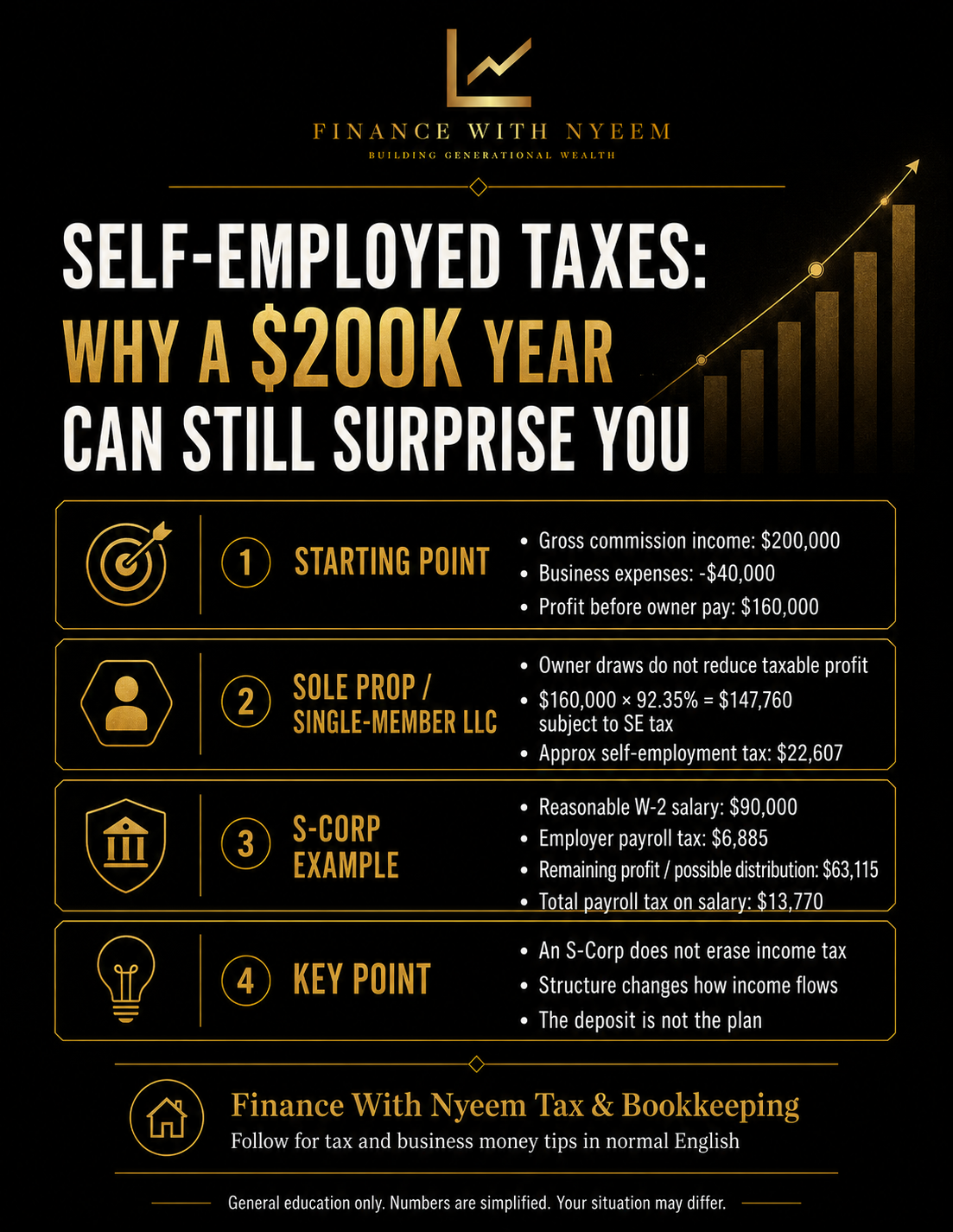
A $200,000 year does not always mean $200,000 of take-home income. Learn how expenses, self-employment tax, S-Corp payroll, owner pay, and tax planning can change the real number.
URL Slug: self-employed-taxes-200k-example
A lot of self-employed people are not surprised by taxes because they are careless.
They are surprised because the money does not flow the same way it does on a normal W-2 paycheck.
When someone has a regular job, taxes are usually withheld before the money hits their bank account. Social Security, Medicare, federal tax withholding, and sometimes other items are already taken out.
But for a self-employed person, contractor, consultant, real estate agent, 1099 worker, or small business owner, the deposit can look much bigger than what they actually get to keep.
That is where people get caught.
The money comes in first.
The tax bill shows up later.
The deposit is not the real number
Let’s use a simple real estate agent example.
Assume an agent has:
Gross commission income: $200,000
Business expenses: $40,000
Profit before owner pay: $160,000
That $160,000 is where the tax conversation really starts.
But the way that money is taxed can depend on how the business is structured, how the owner pays themselves, whether the books are clean, and whether there is an actual plan behind the income.
This is why two people can both gross $200,000 and end up with very different tax situations.
Example 1: Sole prop or single-member LLC
A lot of self-employed people operate as a sole proprietor or single-member LLC.
That can be completely normal.
But here is the part people miss:
Owner draws do not reduce taxable profit.
So if the business has $160,000 of net profit, taking money out as an owner draw does not magically lower that profit. The IRS does not look at the draw and say, “That part is not taxable.”
In a simplified example:
Net profit: $160,000
Amount generally subject to self-employment tax: $160,000 × 92.35%
Subject to self-employment tax: $147,760
At a simplified 15.3% self-employment tax estimate:
Estimated self-employment tax: about $22,607
That is before regular federal income tax.
So the owner may have made good money, but they still need to account for self-employment tax, federal income tax, future expenses, business reserves, and their personal cash flow.
That is why a strong year can still feel tight.
Example 2: S-Corp structure
Now let’s look at a simplified S-Corp example.
An S-Corp does not erase tax.
That is important.
The S-Corp does not make income disappear. The owner may still pay regular income tax on W-2 wages and pass-through business profit.
But the structure can change how part of the income is treated for payroll tax purposes, if it is done correctly.
For example:
Business profit before owner pay: $160,000
Reasonable W-2 salary: $90,000
Employer payroll tax estimate: about $6,885
Remaining business profit / possible distribution: about $63,115
Payroll taxes on the $90,000 salary would be approximately:
Employee payroll tax: about $6,885
Employer payroll tax: about $6,885
Total payroll tax: about $13,770
Compare that to the simplified Schedule C self-employment tax estimate of about $22,607.
That is an estimated difference of about $8,837.
Again, this is not saying the S-Corp saves everyone $8,837.
It is saying the structure, payroll, reasonable compensation, expenses, bookkeeping, retirement planning, and paperwork can change the real tax picture.
The S-Corp is not magic
An S-Corp can be useful, but it comes with rules.
You need payroll.
You need reasonable compensation.
You need clean books.
You need separate business records.
You need to understand what is a wage, what is a distribution, and what is still taxable income.
You also need to account for payroll costs, tax filings, bookkeeping, and the extra administrative work.
For some business owners, the S-Corp may make sense.
For others, it may be too early or not worth the complexity yet.
That decision should be based on the numbers, not TikTok advice or something someone heard from another business owner.
Why self-employed people get surprised
The surprise usually comes from treating gross income like take-home pay.
But the business may still need to pay for:
Vehicle expenses or depreciation
Equipment
Software
Marketing
Insurance
Phone
Home office
Legal paperwork
Bookkeeping
Payroll
Retirement contributions
Quarterly tax payments
Tax reserves
Future slow months
A $200,000 year can be strong, but it still needs a system.
Without a system, the owner may spend from the top-line number and then realize later that taxes, expenses, and reserves were never separated.
The real question
The question is not just:
“How much did I make?”
The better question is:
“What did the business actually keep after expenses, taxes, payroll, owner pay, retirement planning, and paperwork?”
That is the number that matters.
Bottom line
Self-employed taxes are not just about setting money aside.
They are about understanding how your income flows.
A sole proprietor, LLC, partnership, and S-Corp may all handle owner pay differently. Some owners take draws. Some need payroll. Some should be reviewing retirement options. Some are missing deductions. Some have the income but not the system.
The deposit is not the plan.
Finance With Nyeem Tax & Bookkeeping helps Alaska business owners, real estate agents, contractors, consultants, and self-employed professionals understand profit, cash flow, bookkeeping, owner pay, entity structure, and tax planning before deadlines arrive.
A strong year should not turn into a spring surprise.
General education only. Numbers are simplified. This is not tax, legal, or financial advice. Your tax situation may differ. Reasonable compensation, entity structure, deductions, payroll, and tax results depend on the facts.
